Ultra-Fin Systems · Installation Guide

Installation
Made for
Every Build.

New construction, renovation, or retrofit — Ultra-Fin adapts to any joist type and works with all floor coverings.

All Joist Types
Any Floor Covering
0" Floor Build-Up
N/C No Concrete Required
↑↓ New Build or Retro
Compatible Framing Systems

Works with
Every Joist Type

Ultra-Fin is engineered to install cleanly in all standard residential framing systems. No modifications to the structure required.

Solid Wood

Dimensional Lumber Joists

2×8, 2×10, 2×12 and similar solid sawn lumber. The most common joist type in North American residential construction. Ultra-Fin fits between every standard bay width.

Standard fin width fits most bay widths
No modification to lumber required
Works with bridging in place
Engineered Lumber

LVL & Parallam Joists

Laminated veneer lumber and parallel strand lumber joists. Wider flanges and deeper profiles. Ultra-Fin's clip system works identically regardless of joist depth.

Compatible with all standard bay widths
Works with any depth LVL or PSL
Fin spans the full clear distance
Prefabricated

I-Joist (TJI) Systems

OSB web and flanged I-joists are standard in modern construction. The open web allows easy tubing routing. Ultra-Fin clips to the bottom flange with no drilling required.

No drilling through web required
Clips to bottom flange
Easy tubing pass-through at web knockouts
Open Web

Open Web Floor Trusses

Open web trusses offer the most routing flexibility. Web openings allow tubing to pass from bay to bay without any drilling. Ideal for large floor plates.

Free tubing routing through web openings
Easy access for manifold connections
No structural modification required
Step-by-Step Process

How to Install
Ultra-Fin

Follow this sequence for a complete, code-compliant installation.

1

Plan the Circuit Layout

Determine the heating zone layout based on the floor plan. Calculate the total linear footage of tubing required using the Ultra-Fin spacing formula. Mark the supply and return manifold locations. Identify any cross-joist penetrations needed for multi-bay runs.

Use the Ultra-Fin design tool or contact your rep for a custom layout drawing based on your floor plan dimensions.
2

Install Insulation Below the System

Install rigid or batt insulation below the Ultra-Fin system before fin installation. The insulation directs heat upward toward the living space. Minimum R-values are required — see the Specifications page for full insulation requirements by climate zone and floor assembly type.

Insulation must be installed flush against the bottom chord of the joist. Air gaps below the insulation significantly reduce system efficiency.
3

Position and Clip the Fins

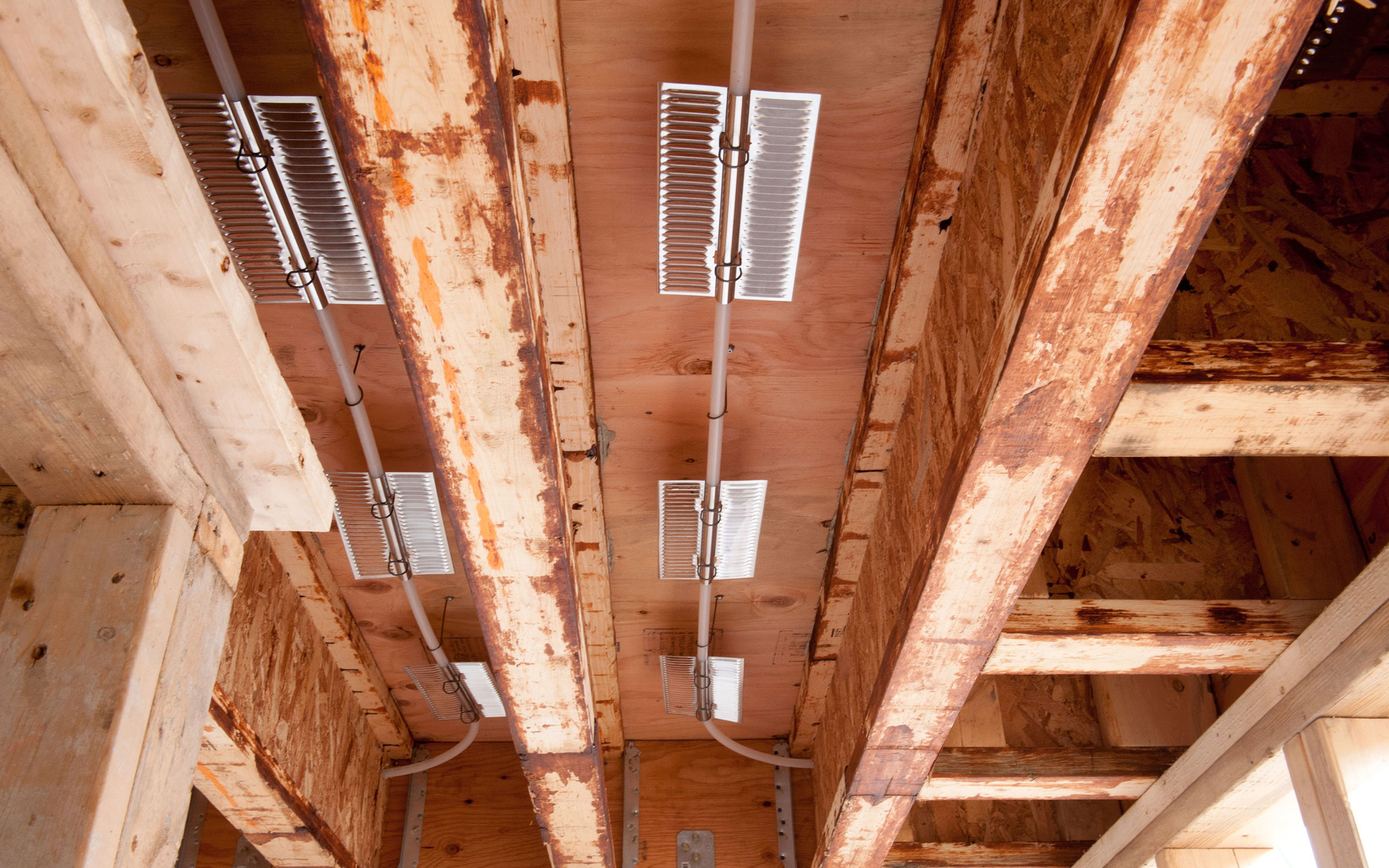
Starting at one end of the joist bay, clip aluminum fins to the underside of the subfloor in the direction of the tubing run. Fins should be positioned at the specified spacing — typically every 8" on center, though this varies by design heat load. Fins span the full width of the joist bay and press firmly against the subfloor above.

4

Thread PEX Tubing Through Fin Clips

Run PEX-A or PEX-B tubing (typically 1/2" or 5/8" OD) through the clip openings in each fin. The tubing runs in a serpentine pattern — back and forth across the joist bay length. Route from bay to bay through pre-drilled holes or web openings as planned in Step 1.

Minimum bend radius: 8× the tubing outside diameter. Never kink PEX tubing around joists. Use elbow fittings or wide-radius guides at bay transitions.
5

Connect to Manifold and Pressure Test

Bring supply and return tubing ends to the manifold location. Connect using appropriate fittings for your tubing type (expansion, compression, or crimp). Pressure test the completed circuit to 60 PSI (or per local code) and hold for a minimum of 30 minutes before closing in.

6

Commission and Balance

Fill the system, purge air from all circuits, and commission the hydronic heat source. Verify supply and return temperatures at each manifold port. Balance flow rates using the manifold balancing valves to achieve design delta-T across each circuit. Monitor floor surface temperature during first heat-up.

Floor surface temperature must not exceed 29°C (84°F) at any point during operation.
Insulation Requirements

Minimum R-Values
by Assembly

Proper insulation below the Ultra-Fin system is critical for efficiency. Without adequate insulation, heat escapes downward rather than warming the floor above.

Important

Insulation must be installed before Ultra-Fin fins are clipped in place. Confirm local code requirements — many jurisdictions specify minimum R-values for radiant floor assemblies.

Assembly Type Min. R-Value Preferred
Over conditioned spaceR-11R-19
Over vented crawlspaceR-19R-30
Over unheated garageR-19R-30
Over exterior (cantilevered)R-30R-38
Over unconditioned basementR-19R-30
Compatible Floor Coverings

Works Under
Any Floor

Ultra-Fin delivers comfortable radiant heat under all common residential floor coverings. Some materials conduct heat more readily — follow manufacturer guidance for temperature limits.

Excellent
🪵
Solid Hardwood
Best results when acclimated properly. Keep floor surface below 27°C. Quartersawn species preferred.
Excellent
📐
Engineered Wood
Dimensionally stable. Tolerates slightly higher surface temperatures than solid wood. Follow manufacturer specs.
Excellent
🏠
Tile & Stone
Best thermal mass — holds heat longer. Pairs well with lower supply temperatures for efficiency.
Excellent
📦
LVP / Luxury Vinyl
Confirm radiant rating from manufacturer. Most major brands support radiant below 27°C surface temp.
Good
🔲
Laminate
Must be rated for radiant heat. Keep moisture content controlled during installation and operation.
Good
🛏️
Carpet & Pad
Low R-value carpet and thin pad recommended. Combined R-value of floor covering should not exceed R-1.5.
Ultra-Fin installation from below — aluminum fins spanning joist bay
Not Sure Where to Start?

Talk to an
Ultra-Fin Rep

Our technical team can review your floor plans, specify the correct fin spacing and tubing layout, and connect you with a certified installer in your region.

Request Design Assistance →