System Overview

How Ultra-Fin
Works

A patented aluminum extrusion that wraps hydronic tubing on three sides — delivering faster heat-up, more even distribution, and superior BTU output compared to any conventional approach.

Section 01 — System Overview

The Core Concept

Turning the Floor Into a Precision Radiator

Conventional radiant systems transfer heat through one small point of contact between a round tube and a flat surface. Ultra-Fin wraps that tube in thermally conductive aluminum on three sides — multiplying the contact area and transforming the floor structure into a high-efficiency heat emitter.

1

The Extrusion is Positioned

Lightweight aluminum extrusion panels are laid across the subfloor or fitted between floor joists. Each panel features a precision-formed U-channel sized to accept 3/8", 1/2", or 5/8" PEX tubing. Built-in spacing tabs maintain consistent tube-to-tube distance without measuring.

6" or 12" O.C. spacing No measuring required Subfloor or joist bay install
2

Tubing Snaps Into the Channel

PEX tubing is pressed into the U-channel. The extrusion geometry grips the tube and wraps it on the bottom and both sides — 270 degrees of direct aluminum-to-tube contact. Heat conducts out of the water and into the aluminum immediately, rather than relying on indirect radiation across an air gap.

270° contact wrap No clips or adhesive PEX-A, PEX-B, PEX-AL-PEX
3

Aluminum Conducts Heat Upward

The aluminum fin — which has roughly 200× the thermal conductivity of wood — absorbs heat from the tubing and distributes it laterally across the panel surface. The full panel width becomes a radiating surface, heating the subfloor and finish floor material above it uniformly.

Lateral heat spreading Full panel surface active No hot or cold stripes
4

Connect, Test, and Cover

Tubing runs connect to the zone manifold using standard PEX fittings. The system is pressure-tested at 80–100 PSI before the finish floor is installed. Any approved finish floor material — hardwood, tile, LVP, carpet, engineered wood — can then be installed directly over the extrusion.
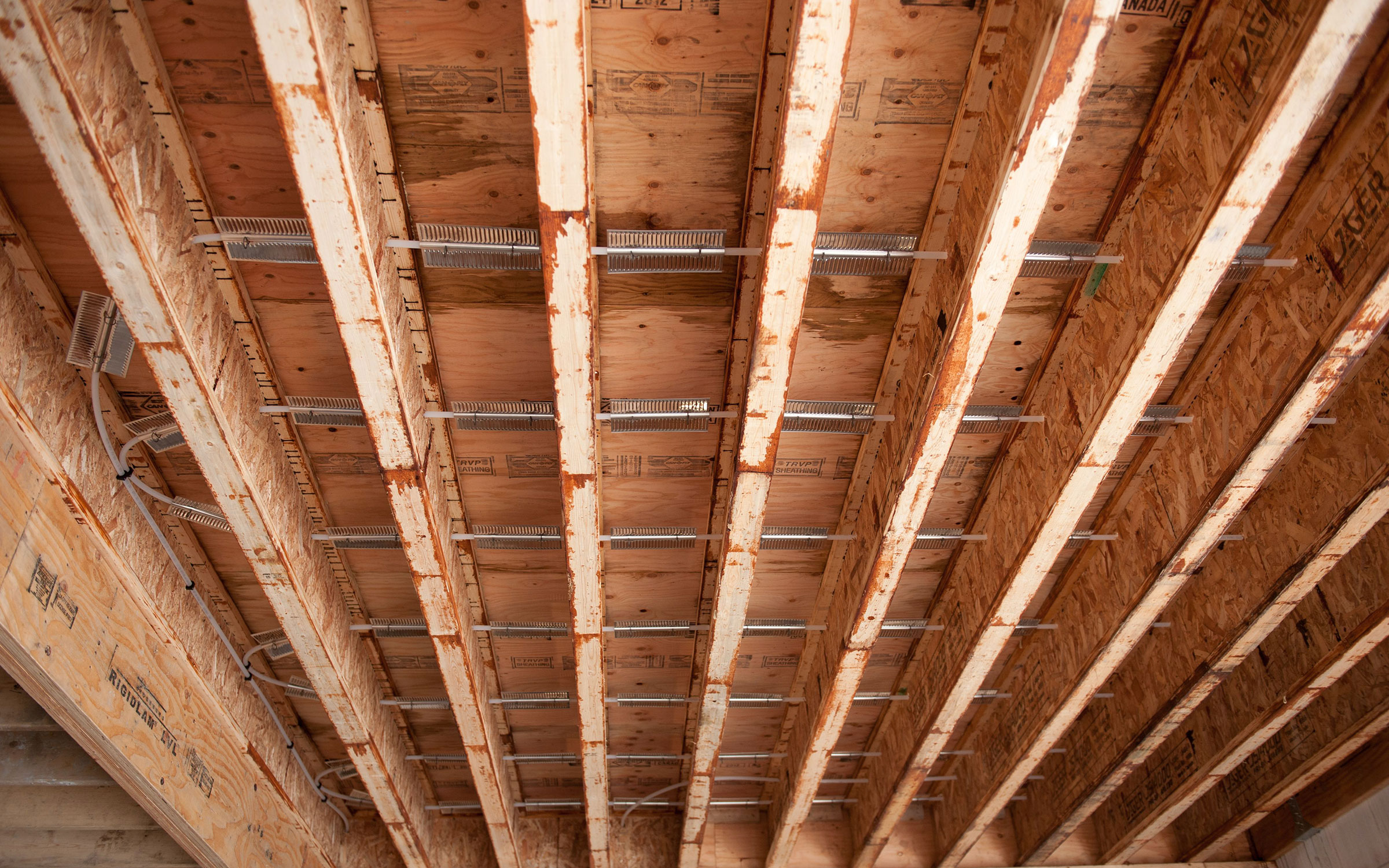
Standard PEX manifold Pressure test: 80–100 PSI All finish floors supported
Ultra-Fin extrusion being installed

Why Aluminum?

Aluminum has a thermal conductivity of ~200 W/m·K — compared to ~0.12 W/m·K for wood. When aluminum surrounds the tubing on three sides, heat moves out of the water and into the floor structure with dramatically less resistance, faster response, and far more even distribution than wood-plate or air-gap alternatives.

Three sides of contact. One step above every alternative.

Heat Transfer Mechanism

Conduction First. Always.

Ultra-Fin's performance advantage is rooted in physics: direct conduction is always faster and more efficient than radiation across an air gap. Here's what that means in practice.

1

Water Temperature Sets the Ceiling

Heat output is ultimately bounded by supply water temperature and flow rate. Ultra-Fin doesn't change physics — it ensures every available BTU leaves the water and enters the floor structure instead of being partially lost to air gaps.

2

Three-Sided Contact Minimizes Resistance

The thermal resistance between the water and the floor surface is a chain of resistances. Three-sided contact removes the largest link: the tube-to-emitter interface. The result is faster warm-up and lower required water temperature for the same output.

3

Lateral Spreading Eliminates Striping

Once heat enters the aluminum, it spreads laterally across the full panel width before reaching the subfloor. The floor surface warms evenly — not in hot lines over the tube and cold zones between runs.

4

Low Delta-T for Condensing Boilers

Because Ultra-Fin extracts heat so efficiently, the return water temperature drops more — increasing delta-T. Condensing boilers operate at peak efficiency when return temps stay below 130°F. Ultra-Fin maximizes condensing hours.

5

Fast Thermal Response

Aluminum's low mass means panels heat up and cool down quickly. When the thermostat calls for heat, the floor responds in minutes — not the 30–45 minute lag typical of embedded-tube concrete systems.

6

Self-Limiting Surface Temperature

As the subfloor warms toward the water temperature, the delta-T between water and floor decreases and heat output drops naturally. The floor self-regulates without additional controls — protecting wood floors at their manufacturer-recommended limits.

Performance Data

How Ultra-Fin Compares

The data below shows real-world differences in heat transfer efficiency, response time, and install burden across the four most common radiant floor heat delivery methods.

Characteristic Ultra-Fin Nail Plate Gypcrete / Concrete Staple-Up
Tube Contact Angle270°90°360°~10°
Emitter MaterialAluminum (200 W/m·K)Steel (50 W/m·K)Concrete (1.5 W/m·K)None (air gap)
Lateral Heat SpreadFull panel widthPartialFull (via mass)None
Warm-Up TimeMinutes15–25 min30–90 min20–35 min
Floor Height ImpactNoneNone+1.5" to 3"None
Structural LoadNoneNone40–60 PSFNone
Min. Water Temp Needed90°F (low-temp capable)110°F100°F130°F+
Works Over Carpeted FloorYesReducedReducedNo
Retrofit CompatibilityExcellentModerateVery limitedModerate
Install Time per 100 SF~1.5 hrs~2.5 hrs~5 hrs + cure~2 hrs

Zoning & Controls

Simple Integration With Any Hydronic System

Ultra-Fin works with every standard hydronic heating control setup — from simple single-zone thermostats to sophisticated multi-zone DDC systems.

Control Compatibility
Thermostat Type
Any 24V hydronic thermostat
Zone Valves
Standard zone valves or circulators
Manifold Type
Any PEX manifold with actuators
Outdoor Reset
Compatible — recommended
Weather Compensation
Supported via boiler control
Smart Thermostats
Ecobee, Nest, Honeywell — all compatible
Multi-Zone
Full support — no limitation on zones
Outdoor reset is strongly recommended. Because Ultra-Fin responds quickly, outdoor reset allows the boiler to modulate water temperature based on actual heat loss — maximizing efficiency and occupant comfort.
Zoning is straightforward. Each tubing loop served by Ultra-Fin behaves like any hydronic radiant loop. Standard manifold-based zoning applies with no special adapters or controllers.

Want to See the Technology Behind the System?

Explore the material science, engineering principles, and design specifications that make Ultra-Fin the most thermally efficient radiant extrusion available.